Can the House Submit Articiles of Impeachment After a President Is Relected?
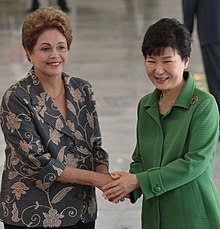
Brazilian president Dilma Rousseff (left) and South Korean president Park Geun-Hye (right) were both impeached and removed from role in 2016.
Impeachment is the process past which a legislative trunk or other legally constituted tribunal initiates charges confronting a public official for misconduct.[1] [two] It may be understood as a unique process involving both political and legal elements.[3] [four] [5]
In Europe and Latin America impeachment tends to be confined to ministerial officials[6] equally the unique nature of their positions may identify ministers beyond the achieve of the police force to prosecute, or their misconduct is not codified into law equally an offense except through the unique expectations of their loftier role. Both "peers and commoners" have been discipline to the procedure however.[seven] From 1990 to 2022 there have been at to the lowest degree 272 impeachment charges against 132 different heads of state in 63 countries.[8] About democracies (with the notable exception of the United states of america) involve the courts (ofttimes a national constitutional court) in some way.[ix] [1]
In Latin America, which includes almost forty% of the world'south presidential systems, ten presidents from half dozen countries were removed from office by their national legislatures via impeachments or declarations of incapacity between 1978 and 2019.[10]
National legislations differ regarding both the consequences and definition of impeachment, merely the intent is nearly always to expeditiously vacate the part. In nearly nations the process begins in the lower house of a bicameral assembly who bring charges of misconduct, so the upper firm administers a trial and sentencing.[6] Nearly commonly, an official is considered impeached subsequently the house votes to have the charges, and impeachment itself does not remove the official from office.[half-dozen]
Considering impeachment involves a divergence from the normal ramble procedures by which individuals accomplish loftier role (election, ratification, or engagement) and because it generally requires a supermajority, they are usually reserved for those deemed to have committed serious abuses of their role.[11] In the United States, for example, impeachment at the federal level is limited to those who may have committed "Treason, Bribery, or other high crimes and misdemeanors"—the latter phrase referring to offenses against the government or the constitution, grave abuses of ability, violations of the public trust, or other political crimes, even if not indictable criminal offenses.[4] [12] Under the United States Constitution, the Firm of Representatives has the sole power of impeachments while the Senate has the sole power to try impeachments (i.e., to acquit or captive); the validity of an impeachment trial is a political question that is nonjusticiable (i.e.., is not reviewable by the courts).[thirteen] In the Us, impeachment is a remedial rather than penal process,[thirteen] [14] : 8 intended to "finer 'maintain constitutional authorities' past removing individuals unfit for role";[14] : 8 persons subject to impeachment and removal remain "liable and discipline to Indictment, Trial, Judgment and Punishment, according to Police."[14]
Impeachment is provided for in the constitutional laws of many countries including Brazil, French republic, Bharat, Ireland, the Philippines, Russia, Due south Korea, and the U.s.a.. Information technology is distinct from the movement of no confidence process bachelor some countries whereby a motion of censure tin be used to remove a government and its ministers from office. Such a process is not applicative in countries with presidential forms of government like the United states.[xv]
Etymology and history [edit]
The discussion "impeachment" probable derives from Old French empeechier from Latin give-and-take impedīre expressing the idea of catching or ensnaring by the 'foot' (pes, pedis), and has analogues in the modern French verb empêcher (to prevent) and the modern English impede. Medieval popular etymology too associated it (wrongly) with derivations from the Latin impetere (to assault).
The process was offset used by the English language "Good Parliament" against William Latimer, 4th Businesswoman Latimer in the 2d one-half of the 14th century. Following the English instance, the constitutions of Virginia (1776), Massachusetts (1780) and other states thereafter adopted the impeachment mechanism, but they restricted the penalty to removal of the official from office.
In West Africa, Kings of the Ashanti Empire who violated any of the oaths taken during his or her enstoolment, were destooled past Kingmakers.[16] For instance, if a king punished citizens arbitrarily or was exposed to be corrupt, he would be destooled. Destoolment entailed Kingmakers removing the sandals of the king and bumping his buttocks on the ground 3 times. One time destooled from function, his sanctity and thus reverence are lost as he cannot practise whatever powers he had equally king; this includes Master administrator, Guess, and Armed services Commander. The now previous king is disposed of the Stool, swords and other regalia which symbolize his role and authority. He also loses the position as custodian of the country. All the same, despite being destooled from office, the king remains a member of the Purple Family from which he was elected.[sixteen]
In diverse jurisdictions [edit]
Brazil [edit]
In Brazil, as in most other Latin American countries, "impeachment" refers to the definitive removal from role. The president of Brazil may be provisionally removed from office by the Chamber of Deputies so tried and definitely removed from office past the Federal Senate. The Brazilian Constitution requires that 2-thirds of the Deputies vote in favor of the opening of the impeachment process of the President and that two-thirds of the Senators vote for impeachment. State governors and municipal mayors can besides exist impeached by the respective legislative bodies. Article 2 of Police nº 1.079, from ten Apr 1950, or "The Police of Impeachment," states that "The crimes defined in this police force, fifty-fifty when but attempted, are discipline to the penalty of loss of office, with disqualification for up to five years for the exercise of any public function, to exist imposed by the Federal Senate in proceedings confronting the President of the Commonwealth, Ministers of State, Ministers of the Supreme Federal Tribunal, or the Attorney General."
Initiation: An accusation of a responsibility crime confronting the President may be brought past whatsoever Brazilian citizen however the President of the Sleeping accommodation of Deputies holds prerogative to accept the accuse, which if accepted will exist read at the adjacent session and reported to the President of the Democracy.
Extraordinary Committee: An boggling commission is elected with fellow member representation from each political political party proportional to that political party's membership. The President is then allowed x parliamentary sessions for defense, which lead to two legislative sessions to form a rapporteur's legal stance as to if impeachment proceedings will or volition non commence in the Senate. The rapporteur's opinion is voted on in the lower house; and on a simple majority information technology is accepted, failing that, the Commission accepts an opinion produced by the majority. example, if the rapporteur's opinion is that no impeachment is warranted, and the Committee vote fails to accept it, then the Committee adopts the opinion to continue with impeachment. Likewise, if the rapporteur's stance is to proceed with impeachment, and the Committee vote fails, then the Committee adopts the opinion non to impeach. If the vote succeeds, and then the rapporteur'south stance is and then adopted.
Chamber of Deputies: The Chamber issues a call-out vote to accept the opinion of the committee, requiring either a supermajority in favor of an impeachment opinion, or a supermajority against a dismissal opinion to authorize the Senate impeachment proceedings.
The Senate: The procedure in the Senate had been historically defective in procedural guidance until 1992, when the Federal Senate published in the Official Diary of the Union the footstep-past-step procedure of the Senate's impeachment process, which involves the formation of another special committee and closely resembles the lower house process, with time constraints imposed on the steps taken. The committee's opinion must be presented inside 10 days, after which it is put to a call-out vote at the next session. The vote must continue within a unmarried session; the vote on President Rousseff endured for over 20 hours. A simple bulk vote in the Senate begins formal deliberation on the complaint, suspends the President from office, installs the Vice President equally acting president, and begins a 20-twenty-four hours catamenia for written defense as well equally 180-days for a trial. Failing that, the case is closed
Senate plenary deliberation: The committee interrogates the accused or their counsel, from which they take a right to abstain, and also a probative session which guarantees the accused rights to contradiction, or audiatur et altera pars, allowing access to the courts and due process of law under Article 5 of the constitution. The accused has 15 days to present written arguments in defense and answer to the bear witness gathered, then the committee shall issue an opinion on the merits within 10 days. The unabridged package is published for each senator before a single plenary session issues a phone call-out vote, which shall go on to trial on a simple bulk and close the case otherwise.
Senate trial: A hearing for the complainant and the defendant convenes within 48 hours of notification from deliberation, from which a trial is scheduled by the president of the Supreme Court no less than ten days after the hearing. The senators sit down every bit judges as witnesses are interrogated and cross-examined; all questions must exist presented to the president of the Supreme Court, who presides over the trial. The president of the Supreme Court allots time for argue and rebuttal, subsequently which time the parties go out the chamber and the senate deliberates on indictment. The President of the Supreme Courtroom reads the summary of the grounds, the charges, the defense and the prove to the Senate, who each in turn issue their sentence. On indictment by a supermajority, the president of the Supreme Court pronounces the sentence and the accused is immediately notified. This concludes the proceeding if the accused was not already acquitted.
Upon confidence, the officer has their political rights revoked for viii years—which bars them from running for any part during that fourth dimension.[17]
Fernando Collor de Mello, the 32nd President of Brazil, resigned in 1992 amongst impeachment proceedings. Despite his resignation, the Senate nonetheless voted to captive him and bar him from belongings any function for eight years, due to prove of bribery and misappropriation.
In 2016, the Chamber of Deputies initiated an impeachment instance against President Dilma Rousseff on allegations of budgetary mismanagement.[18] On 12 May 2016, after xx hours of deliberation, the admissibility of the responsibleness crime accusation was approved by the Senate with 55 votes in favor and 22 against, and Vice President Michel Temer was notified to presume the duties of the President pending trial. On August 31, 61 senators voted in favor of impeachment and twenty voting against it, achieving the two/three majority needed for Rousseff'south removal.The vote to disqualify her for five years failed having only 42 years.[17]
Croatia [edit]
The process of impeaching the president of Republic of croatia can exist initiated by a two-thirds bulk vote in favor in the Sabor and is thereafter referred to the Ramble Court, which must have such a proposal with a two-thirds majority vote in favor in order for the president to be removed from office. This has never occurred in the history of the Republic of Croatia. In case of a successful impeachment motion a president'due south constitutional term of v years would exist terminated and an ballot chosen inside 60 days of the vacancy occurring. During the period of vacancy the presidential powers and duties would exist carried out by the speaker of the Croatian Parliament in his/her chapters as Acting President of the Republic.[19]
Czechia [edit]
In 2013, the constitution was changed. Since 2013, the procedure tin be started by at least 3-fifths of present senators, and must be approved by at to the lowest degree three-fifths of all members of the Chamber of Deputies. Likewise, the President can be impeached for high treason (newly defined in the Constitution) or whatever serious infringement of the Constitution.[20]
The process starts in the Senate of the Czech Commonwealth which has the right to only impeach the president, and the Senate passes the case to the Constitutional Court of the Czech Republic, which has to decide the verdict confronting the president. If the Court finds the President guilty, and then the President is removed from part and is permanently barred from existence elected President of the Czechia again.[21]
No Czech president has always been impeached, though members of the Senate sought to impeach President Václav Klaus in 2013.[22] This example was dismissed past the court, which reasoned that his mandate had expired.[23]
Kingdom of denmark [edit]
In Denmark the possibility for current and former ministers being impeached was established with the Danish Constitution of 1849. Unlike many other countries Denmark does non take a Ramble Court who would unremarkably handle these types of cases. Instead Denmark has a special Court of Impeachment (In Danish: Rigsretten) which is called upon every fourth dimension a electric current and erstwhile minister take been impeached. The role of the Impeachment Court is to process and deliver judgments confronting electric current and former ministers who are defendant of unlawful conduct in role. The legal content of ministerial responsibility is laid down in the Ministerial Accountability Human action which has its background in section thirteen of the Danish Constitution, according to which the ministers' accountability is adamant in more particular by law. In Denmark the normal do in terms of impeachment cases is that it needs to be brought up in the Danish Parliament (Folketing) first for argue between the unlike members and parties in the parliament. Afterwards the contend the members of the Danish Parliament vote on whether a current or onetime minister needs to exist impeached. If at that place is a majority in the Danish Parliament for an impeachment case against a current or former minister, an Impeachment Courtroom is chosen into session. In Denmark the Impeachment Courtroom consists of upwards to 15 Supreme Court judges and 15 parliament members appointed by the Danish Parliament. The members of the Impeachment Court in Denmark serve a six-year term in this position.[24]
In 1995 the former Government minister of Justice Erik Ninn-Hansen from the Bourgeois People's Political party was impeached in connection with the Tamil Case. The example was centered around the illegal processing of family reunification applications. From September 1987 to January 1989 applications for family reunification of Tamil refugees from ceremonious war-torn Sri Lanka were put on agree in violation of Danish and International police force. On 22 June 1995, Ninn-Hansen was found guilty of violating paragraph 5 subsection one of the Danish Ministerial Responsibility Human activity which says: A minister is punished if he intentionally or through gross negligence neglects the duties incumbent on him under the constitution or legislation in general or co-ordinate to the nature of his post. A bulk of the judges in that impeachment case voted for former Government minister of Justice Erik Ninn-Hansen to receive a suspended sentence of four months with one year of probation. The reason why the sentence was made suspended was especially in relation to Ninn-Hansen's personal circumstances, in detail, his health and age - Ninn-Hansen was 73 years old when the sentence was handed down. After the verdict, Ninn-Hansen complained to the European Court of Human Rights and complained, among other things, that the Court of Impeachment was not impartial. The European Court of Human Rights dismissed the complaint on eighteen May 1999. As a direct result and issue of this case, the Conservative-led government and Prime Minister at that fourth dimension Poul Schlüter was forced to stride downwardly from ability. [25] [26]
In February 2022 the quondam Government minister for Clearing and Integration Inger Støjberg at that time member of the Danish Liberal Party Venstre was impeached when it was discovered that she had maybe against both Danish and International law tried to separate couples in refugee centres in Denmark, as the wives of the couples were under legal historic period. According to a commission report Inger Støjberg had too lied in the Danish Parliament and failed to written report relevant details to the Parliamentary Ombudsman[27] The decision to initiate an impeachment example was adopted by the Danish Parliament with a 141-30 vote and decision (In Denmark 90 members of the parliament demand to vote for impeachment before it can be implemented). On 13 December 2022 former Minister for Immigration and Integration Inger Støjberg was convicted by the special Court of Impeachment of separating asylum seeker families illegally co-ordinate to Danish and international law and sentenced to 60 days in prison house.[28] The majority of the judges in the special Courtroom of Impeachment (25 out of 26 judges) constitute that it had been proven that Inger Støjberg on 10 Feb 2022 decided that an accommodation scheme should apply without the possibility of exceptions, so that all asylum-seeking spouses and cohabiting couples where one was a minor aged 15-17, had to be separated and accommodated separately in split asylum centers.[29] On 21 December, a majority in the Folketing voted that the sentence ways that she is no longer worthy of sitting in the Folketing and she therefore immediately lost her seat.[30]
France [edit]
In France the comparable procedure is chosen destitution. The president of France can be impeached by the French Parliament for willfully violating the Constitution or the national laws. The process of impeachment is written in the 68th commodity of the French Constitution.[31] A grouping of senators or a grouping of members of the National Assembly tin brainstorm the process. Then, both the National Associates and the Senate must acknowledge the impeachment. After the upper and lower houses' agreement, they unite to grade the High Court. Finally, the Loftier Court must determine to declare the impeachment of the president of France—or not.
Germany [edit]
The federal president of Federal republic of germany can exist impeached both by the Bundestag and by the Bundesrat for willfully violating federal constabulary. In one case the Bundestag or the Bundesrat impeaches the president, the Federal Ramble Court decides whether the President is guilty as charged and, if this is the case, whether to remove him or her from part. The Federal Ramble Courtroom likewise has the ability to remove federal judges from office for willfully violating cadre principles of the federal constitution or a state constitution. The impeachment procedure is regulated in Article 61 of the Basic Constabulary for the Federal Republic of Germany.
There is no formal impeachment procedure for the chancellor of Germany, even so the Bundestag tin replace the chancellor at whatsoever time by voting for a new chancellor (constructive vote of no conviction, Commodity 67 of the Bones Constabulary).
There has never been an impeachment against the President so far. Constructive votes of no conviction against the chancellor occurred in 1972 and 1982, with only the second one being successful.
Hong Kong [edit]
The master executive of Hong Kong can be impeached by the Legislative Quango. A motion for investigation, initiated jointly by at least one-4th of all the legislators charging the Main Executive with "serious breach of law or dereliction of duty" and refusing to resign, shall first be passed by the council. An independent investigation committee, chaired by the chief justice of the Courtroom of Final Entreatment, will and then bear out the investigation and report back to the council. If the Council find the evidence sufficient to substantiate the charges, it may laissez passer a motion of impeachment by a two-thirds majority.[32] : Article 73(ix)
However, the Legislative Council does not have the ability to actually remove the chief executive from office, as the main executive is appointed by the Central People's Government (Land Council of Prc). The quango tin but report the result to the Central People's Government for its determination.[32] : Article 45
Republic of hungary [edit]
Commodity xiii of Hungary's Fundamental Law (constitution) provides for the procedure of impeaching and removing the president. The president enjoys amnesty from criminal prosecution while in office, merely may be charged with crimes committed during his term afterwards. Should the president violate the constitution while discharging his duties or commit a willful criminal criminal offense, he may be removed from role. Removal proceedings may be proposed by the concurring recommendation of i-fifth of the 199 members of the land's unicameral Parliament. Parliament votes on the proposal past secret ballot, and if two thirds of all representatives agree, the president is impeached. Once impeached, the president's powers are suspended, and the Constitutional Courtroom decides whether or non the President should be removed from office.[33] [34]
Bharat [edit]
The president and judges, including the chief justice of the supreme court and high courts, can exist impeached by the parliament earlier the expiry of the term for violation of the Constitution. Other than impeachment, no other penalty can be given to a president in position for the violation of the Constitution under Article 361 of the constitution. Yet a president later on his/her term/removal can be punished for his already proven unlawful activeness under disrespecting the constitution, etc.[35] No president has faced impeachment proceedings. Hence, the provisions for impeachment accept never been tested. The sitting president cannot exist charged and needs to step down in order for that to happen.
Ireland [edit]
In the Republic of Republic of ireland formal impeachment applies but to the Irish president. Article 12 of the Irish Constitution provides that, unless judged to be "permanently incapacitated" past the Supreme Courtroom, the president tin be removed from part but by the houses of the Oireachtas (parliament) and only for the commission of "stated misbehaviour". Either house of the Oireachtas may impeach the president, but just by a resolution approved by a bulk of at least two thirds of its total number of members; and a house may not consider a proposal for impeachment unless requested to do so by at least xxx of its number.
Where ane house impeaches the president, the remaining house either investigates the accuse or commissions another torso or committee to do then. The investigating firm tin remove the president if information technology decides, past at least a two-thirds bulk of its members, both that the president is guilty of the accuse and that the charge is sufficiently serious equally to warrant the president'south removal. To date no impeachment of an Irish president has ever taken place. The president holds a largely ceremonial office, the dignity of which is considered important, then it is likely that a president would resign from office long before undergoing formal conviction or impeachment.
Italy [edit]
In Italy, according to Article xc of the Constitution, the President of Italy can be impeached through a majority vote of the Parliament in articulation session for high treason and for attempting to overthrow the Constitution. If impeached, the president of the Commonwealth is then tried past the Constitutional Courtroom integrated with xvi citizens older than xl chosen past lot from a list compiled by the Parliament every nine years.
Italian printing and political forces made utilize of the term "impeachment" for the endeavour by some members of parliamentary opposition to initiate the procedure provided for in Article ninety against Presidents Francesco Cossiga (1991),[36] [ better source needed ] Giorgio Napolitano (2014)[37] [ better source needed ] and Sergio Mattarella (2018).[38] [ better source needed ]
Japan [edit]
By Article 78 of the Constitution of Japan, judges can be impeached.[39] The voting method is specified past laws. The National Diet has two organs and they are 裁判官訴追委員会(Saibankan sotsui iinkai) and 裁判官弾劾裁判所(Saibankan dangai saibansho), which is established by Article 64 of the Constitution.[40] The one-time has a role like to prosecutor and the latter is analogous to Courtroom. 7 judges were removed by them.
Liechtenstein [edit]
Members of the Liechtenstein Government tin can exist impeached earlier the State Court for breaches of the Constitution or of other laws.[41] : Article 62 As a hereditary monarchy the Sovereign Prince can non be impeached every bit he "is not subject to the jurisdiction of the courts and does not accept legal responsibleness".[41] : Article seven The aforementioned is true of any fellow member of the Princely House who exercises the function of head of state should the Prince exist temporarily prevented or in grooming for the Succession.[41] : Commodity vii
Republic of lithuania [edit]

In the Republic of Republic of lithuania, the president may exist impeached by a iii-fifths bulk in the Seimas.[42] President Rolandas Paksas was removed from office by impeachment on half-dozen Apr 2004 after the Constitutional Court of Lithuania found him guilty of having violated his oath and the constitution. He was the first European head of land to accept been impeached.[43]
Norway [edit]
Members of regime, representatives of the national associates (Stortinget) and Supreme Court judges can be impeached for criminal offenses tied to their duties and committed in office, according to the Constitution of 1814, §§ 86 and 87. The procedural rules were modeled after the U.S. rules and are quite similar to them. Impeachment has been used 8 times since 1814, final in 1927. Many debate that impeachment has fallen into desuetude. In cases of impeachment, an appointed court (Riksrett) takes result.
Philippines [edit]
Impeachment in the Philippines follows procedures like to the United States. Nether Sectionsii and 3, Article XI, Constitution of the Philippines, the House of Representatives of the Philippines has the exclusive power to initiate all cases of impeachment against the president, vice president, members of the Supreme Court, members of the Ramble Commissions (Commission on Elections, Civil Service Commission and the Commission on Audit), and the ombudsman. When a 3rd of its membership has endorsed the impeachment manufactures, it is then transmitted to the Senate of the Philippines which tries and determine, every bit impeachment tribunal, the impeachment case.[44]
A master difference from U.Southward. proceedings withal is that but 1 tertiary of Firm members are required to approve the motion to impeach the president (as opposed to a simple majority of those nowadays and voting in their U.S. counterpart). In the Senate, selected members of the Business firm of Representatives act as the prosecutors and the senators deed equally judges with the Senate president presiding over the proceedings (the chief justice jointly presides with the Senate president if the president is on trial). Like the The states, to convict the official in question requires that a minimum of two thirds (i.e. sixteen of 24 members) of all the members of the Senate vote in favor of confidence. If an impeachment endeavor is unsuccessful or the official is acquitted, no new cases can be filed against that impeachable official for at least 1 full year.
Impeachment proceedings and attempts [edit]
President Joseph Estrada was the first official impeached past the Business firm in 2000, simply the trial concluded prematurely due to outrage over a vote to open up an envelope where that motion was narrowly defeated by his allies. Estrada was deposed days afterward during the 2001 EDSA Revolution.
In 2005, 2006, 2007 and 2008, impeachment complaints were filed against President Gloria Macapagal Arroyo, just none of the cases reached the required endorsement of 1⁄3 of the members for transmittal to, and trial by, the Senate.
In March 2011, the House of Representatives impeached Ombudsman Merceditas Gutierrez, becoming the 2nd person to be impeached. In April, Gutierrez resigned prior to the Senate's convening equally an impeachment courtroom.
In December 2011, in what was described as "blitzkrieg way", 188 of the 285 members of the Business firm of Representatives voted to transmit the 56-page Articles of Impeachment against Supreme Court chief justice Renato Corona.
To date, three officials had been successfully impeached by the House of Representatives, and ii were non convicted. The latter, Chief Justice Renato C. Corona, was bedevilled on 29 May 2012, by the Senate under Article II of the Manufactures of Impeachment (for betraying public trust), with 20–3 votes from the Senator Judges.
Peru [edit]
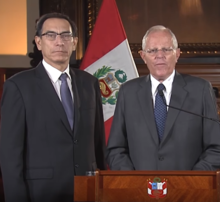
The first impeachment procedure confronting Pedro Pablo Kuczynski, then the incumbent President of Peru since 2016, was initiated by the Congress of Peru on fifteen December 2017. According to Luis Galarreta, the President of the Congress, the whole process of impeachment could have taken as little as a calendar week to complete.[45] This effect was part of the second phase of the political crunch generated past the confrontation between the Government of Pedro Pablo Kuczynski and the Congress, in which the opposition Popular Force has an absolute majority. The impeachment request was rejected by the congress on 21 Dec 2017, for failing to obtain sufficient votes for the deposition.[46]
Romania [edit]
The president can be impeached by Parliament and is and so suspended. A plebiscite so follows to determine whether the suspended President should be removed from part. President Traian Băsescu was impeached twice by the Parliament: in 2007 and then again in July 2012. A referendum was held on 19 May 2007 and a large majority of the electorate voted against removing the president from office. For the most recent suspension a referendum was held on July 29, 2012; the results were heavily against the president, but the referendum was invalidated due to low turnout.[47] [ circular reference ]
Russian federation [edit]

Boris Yeltsin, every bit president of Russia, survived several impeachment attempts
In 1999, members of the State Duma of Russia, led by the Communist Political party of the Russian federation, unsuccessfully attempted to impeach President Boris Yeltsin on charges relating to his function in the 1993 Russian constitutional crisis and launching the First Chechen War (1995–96); efforts to launch impeachment proceedings failed.[48] [49] [l]
Singapore [edit]
The Constitution of Singapore allows the impeachment of a sitting president on charges of treason, violation of the Constitution, corruption, or attempting to mislead the Presidential Elections Committee for the purpose of demonstrating eligibility to be elected as president. The prime government minister or at to the lowest degree one-quarter of all members of Parliament (MPs) can laissez passer an impeachment motion, which can succeed only if at to the lowest degree half of all MPs (excluding nominated members) vote in favor, whereupon the chief justice of the Supreme Court will engage a tribunal to investigate allegations against the president. If the tribunal finds the president guilty, or otherwise declares that the president is "permanently incapable of discharging the functions of his office past reason of mental or physical infirmity", Parliament will agree a vote on a resolution to remove the president from role, which requires a three-quarters majority to succeed.[51] No president has ever been removed from office in this fashion.
Due south Africa [edit]
When the Spousal relationship of South Africa was established in 1910, the just officials who could exist impeached (though the term itself was not used) were the chief justice and judges of the Supreme Court of Due south Africa. The scope was broadened when the land became a commonwealth in 1961, to include the state president. It was farther broadened in 1981 to include the new office of vice state president; and in 1994 to include the executive deputy presidents, the public protector and the Accountant-General. Since 1997, members of certain commissions established by the Constitution tin besides exist impeached. The grounds for impeachment, and the procedures to be followed, have inverse several times over the years.
South Korea [edit]
According to the Article 65 Clause 1 of Constitution of South Korea, if President, Prime number Minister, or other land council members including Supreme Court and Constitutional court members, violate the Constitution or other laws of official duty, the National Assembly tin can impeach them. Clauseii states the impeachment bill may be proposed past one third or more than of the total members of the National Assembly, and shall require bulk voting and approved by 2 thirds or more than of the total members of the National Assembly. This article also states that any person against whom a motion for impeachment has been passed shall be suspended from exercising his ability until the impeachment has been adjudicated and shall not extend farther than removal from public role, provided that it shall non exempt the person impeached from civil or criminal liability.
Two presidents have been impeached since the establishing of the South korea in 1948. Roh Moo-hyun in 2004 was impeached by the National Assembly but was overturned past the Constitutional Court. Park Geun-hye in 2022 was impeached by the National Associates, and the impeachment was confirmed by the Constitutional Court on March 10, 2017.[52] [53]
In Feb 2021, Approximate Lim Seong-geun of the Busan Loftier Court was impeached by the National Associates for meddling in politically sensitive trials, the first ever impeachment of a judge in Korean history. Unlike presidential impeachments, but a simple majority is required to impeach.[54]
Turkey [edit]
In Turkey, according to the Constitution, the G National Assembly may initiate an investigation of the president, the vice president or any fellow member of the Cabinet upon the proposal of simple majority of its total members, and inside a period less than a month, the approval of three-fifths of the total members.[55] The investigation would exist carried out by a commission of xv members of the Associates, each nominated by the political parties in proportion to their representation therein. The committee would submit its written report indicating the outcome of the investigation to the speaker within two months. If the investigation is non completed inside this period, the committee'south fourth dimension may exist renewed for some other month. Inside x days of its submission to the speaker, the report would be distributed to all members of the Assembly, and ten days after its distribution, the report would exist discussed on the floor. Upon the approval of 2 thirds of the total number of the Assembly by underground vote, the person or persons, about whom the investigation was conducted, may be tried before the Ramble Courtroom. The trial would be finalized within three months, and if not, a one-time additional period of three months shall be granted. The president, about whom an investigation has been initiated, may not phone call for an ballot. The president, who is bedevilled by the Courtroom, would be removed from part.
The provision of this commodity shall also use to the offenses for which the president allegedly worked during his term of office.
Ukraine [edit]
During the crisis which started in November 2013, the increasing political stress of the face-down between the protestors occupying Independence Foursquare in Kyiv and the State Security forces under the command of President Yanukovych led to deadly armed force being used on the protestors. Following the negotiated return of Kyiv'south Urban center Hall on xvi Feb 2014, occupied by the protesters since November 2013, the security forces thought they could also retake "Maidan", Independence Square. The ensuing fighting from 17 through 21 February 2022 resulted in a considerable number of deaths and a more than generalised alienation of the population, and the withdrawal of President Yanukovych to his support area in the East of Ukraine.
In the wake of the president's departure, Parliament convened on 22 Feb; it reinstated the 2004 Constitution, which reduced presidential authorisation, and voted impeachment of President Yanukovych as de facto recognition of his divergence from office as President of an integrated Ukraine. The president riposted that Parliament's acts were illegal as they could laissez passer into police force only by presidential signature.
Great britain [edit]
In the United kingdom, in principle, everyone may exist prosecuted and tried by the 2 Houses of Parliament for whatever crime.[56] The first recorded impeachment is that of William Latimer, 4th Baron Latimer during the Good Parliament of 1376. The latest was that of Henry Dundas, 1st Viscount Melville which started in 1805 and which ended with his acquittal in June 1806.[57] Over the centuries, the process has been supplemented by other forms of oversight including select committees, confidence motions, and judicial review, while the privilege of peers to trial but in the House of Lords was abolished in 1948,[58] and thus impeachment, which has not kept up with modernistic norms of democracy or procedural fairness, is mostly considered obsolete.[56]
Usa [edit]
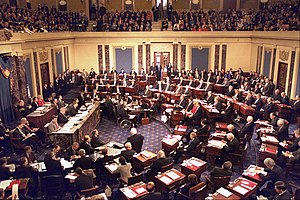

United States president Donald Trump was impeached by the House of Representatives in 2019, and then again in 2021, with one week left in function.
In the federal system, the Article Ane of the United States Constitution provides that the House of Representatives has the "sole Ability of Impeachment" and the Senate has "the sole Ability to try all Impeachments."[59] Article Two provides that "The President, Vice President and all civil Officers of the United States, shall exist removed from Role on Impeachment for, and Conviction of, Treason, Bribery, or other high Crimes and Misdemeanors."[60] In the United States, impeachment is the get-go of 2 stages; an official may be impeached by a majority vote of the Firm, only conviction and removal from part in the Senate requires "the concurrence of two thirds of the members present".[61] Impeachment is analogous to an indictment.[62]
According to the Firm practise manual, "Impeachment is a constitutional remedy to address serious offenses confronting the organisation of authorities. It is the outset step in a remedial process—that of removal from public function and possible disqualification from holding further office. The purpose of impeachment is not punishment; rather, its function is primarily to maintain constitutional government."[63] Impeachment may be understood as a unique process involving both political and legal elements.[iii] [4] [5] The Constitution provides that "Judgment in Cases of Impeachment shall non extend further than to removal from Office, and disqualification to hold and relish any Office of honor, Trust or Profit under the United States: but the Party bedevilled shall all the same be liable and subject field to Indictment, Trial, Judgment and Punishment, according to Constabulary."[64] Information technology is by and large accepted that "a former President may be prosecuted for crimes of which he was acquitted past the Senate."[65]
The U.S. House of Representatives has impeached an official 21 times since 1789: four times for presidents, 15 times for federal judges, one time for a Cabinet secretary, and once for a senator.[66] Of the 21, the Senate voted to remove 8 (all federal judges) from role.[66] The 4 impeachments of presidents were: Andrew Johnson in 1868, Neb Clinton in 1998, and Donald Trump twice: first in 2019, and a second time in 2021.[67] All 4 impeachments were followed by acquittal in the Senate.[66] An impeachment process was besides commenced confronting Richard Nixon, but he resigned in 1974 to avoid likely removal from role.[68]
About all state constitutions set along parallel impeachment procedures for state governments, assuasive the state legislature to impeach officials of the state government.[69] From 1789 through 2008, 14 governors have been impeached (including two who were impeached twice), of whom 7 governors were convicted.[seventy]
Encounter also [edit]
- List of impeachments of heads of state
References [edit]
- ^ a b "impeachment | Definition, Process, History, & Facts". Encyclopedia Britannica . Retrieved 15 November 2020.
- ^ Landau, Sidney; Brantley, Sheila; Davis, Samuel; Koenigsberg, Ruth, eds. (1997). Funk & Wagnall's Standard Desk-bound Dictionary. Vol. i (1996 ed.). U.s.a.: Harper & Row, Publishers, Inc. p. 322. ISBN978-0-308-10353-5.
one. To accuse (a high public official) before a legally constituted tribunal with criminal offence or misdemeanor in function. 2. To bring ignominy upon the honesty or validity of.
- ^ a b Michael J. Gerhardt. "Impeachment is the constabulary. Saying 'political procedure' only helps Trump's narrative". Washington Postal service.
while it's truthful that politics are spring upwardly in how impeachment plays out, information technology's a myth that impeachment is just political. Rather, it'due south the principal legal remedy that the Constitution expressly specifies to agree presidents accountable
- ^ a b c Michael J. Gerhardt (2019). The Federal Impeachment Process: A Constitutional and Historical Analysis (3d ed.). University of Chicago Printing. pp. 106–07.
The ratification debates support the conclusion that 'other loftier Crimes and Misdemeanors' were not limited to indictable offenses but rather included dandy offenses against the federal government. ... Justices James Wilson and Joseph Story expressed agreement with Hamilton's understanding of impeachment every bit a political proceeding and impeachable offenses as political crimes.
- ^ a b Gerhardt, Michael (2018). Impeachment: What Everyone Needs to Know. New York, North.Y.: Oxford University Press. p. 20. ISBN978-0190903657. LCCN 2018013560.
Impeachment has elements of both legal and political proceedings. As a result, it is a unique process.
- ^ a b c Davidson, Roger (2005). "Impeachment". World Book Encyclopedia. Vol. I 10 (2005 ed.). Chicago. p. 92. ISBN0-7166-0105-2.
- ^ "Impeachment". UK Parliament Glossary . Retrieved 5 February 2021.
Impeachment is when a peer or commoner is accused of 'loftier crimes and misdemeanours, across the reach of the law or which no other authority in the state volition prosecute.'
- ^ Lawler, David. "What impeaching leaders looks similar around the world". Axios . Retrieved 8 February 2021.
- ^ Huq, Aziz; Ginsburg, Tom; Landau, David. "Designing Better Impeachments: How other countries' constitutions protect against political free-for-alls". Boston Review . Retrieved 8 February 2021.
Constitutions in 9 democracies give a courtroom—often the country's constitutional court—the power to begin an impeachment; another 61 constitutions identify the court at the end of the process.
- ^ Ignacio Arana Araya, To Impeach or Not to Impeach: Lessons from Latin America, Georgetown Journal of International Affairs (December thirteen, 2019).
- ^ Erskine, Daniel H. (2008). "The Trial of Queen Caroline and the Impeachment of President Clinton: Law As a Weapon for Political Reform". Washington Academy Global Studies Law Review. 7 (1). ISSN 1546-6981.
- ^ Peter Brandon Bayer (23 May 2019). "The Constitution dictates that impeachment must not be partisan". The Chat.
Noted scholars Ronald Rotunda and John Nowak explain that the Framers wisely intended the phrase "or other loftier Crimes and Misdemeanors" to include undermining the Constitution and similar, "cracking offenses against the federal government (like abuse of power) fifty-fifty if they are not necessarily crimes.' For instance, Alexander Hamilton asserted that, while probable to exist criminal acts, impeachable wrongdoings 'are those offenses which proceed from the misconduct of public men ... from the abuse or violation of some public trust.' James Madison urged that impeachment is appropriate for 'loss of chapters, or corruption ... [that] might be fatal to the commonwealth.'
- ^ a b "Impeachment". U.Due south. Constitution Annotated. Congressional Research Service – via Legal Information Institute, Cornell Law School.
- ^ a b c Cole, J. P.; Garvey, T. (29 October 2015). "Study No. R44260, Impeachment and Removal" (PDF). Congressional Inquiry Service. pp. xv–16. Archived (PDF) from the original on 19 Dec 2019. Retrieved 22 September 2016.
- ^ Hauss, Charles (29 December 2006). "Vote of confidence". Britannica . Retrieved 9 Feb 2021.
{{cite web}}: CS1 maint: url-status (link) - ^ a b Obeng, J.Pashington (1996). Asante Catholicism; Religious and Cultural Reproduction among the Akan of Republic of ghana. Vol. 1. ISBN978-90-04-10631-4.
- ^ a b Maciel, Lourenço (8 February 2020). "Was it a coup? Republic and Constitutionality in the 2022 Brazilian Impeachment Process". Dilma Rousseff's Impeachment . Retrieved v March 2021.
{{cite spider web}}: CS1 maint: url-condition (link) - ^ Andrew Jacobs (17 April 2016). "Brazil's Lower House of Congress Votes for Impeachment of Dilma Rousseff". The New York Times. Archived from the original on 3 January 2022. Retrieved xiii November 2016.
- ^ "Constitution of Croatia". § 105. Archived from the original (PDF) on 28 June 2018. Retrieved 12 March 2017.
- ^ Ústava České republiky. Psp.cz. Retrieved on 2016-10-23.
- ^ Ústava České republiky. Psp.cz. Retrieved 2013-07-12.
- ^ "Czech President Vaclav Klaus faces treason charge". BBC News. 4 March 2013. Retrieved 23 October 2016.
- ^ Rob Cameron (28 March 2013). "Constitutional Courtroom throws out treason charges against ex-president Klaus". Radio Praha.
- ^ https://www.thedanishparliament.dk/-/media/pdf/publikationer/english/the_constitutional_act_of_denmark_2013,-d-,pdf.ashx - The Danish Constitution
- ^ https://danmarkshistorien.dk/leksikon-og-kilder/vis/materiale/tamilsagen-1986-1995/ - Tamil Case 1986-1995
- ^ https://hudoc.echr.coe.int/eng#{%22itemid%22 - NINN-HANSEN v. DENMARK
- ^ https://www.euronews.com/2021/01/fourteen/inger-st-jberg-denmark-s-ex-immigration-minister-fix-to-face-impeachment-trial - Inger Støjberg: Denmark's ex-immigration government minister gear up to face impeachment trial
- ^ https://world wide web.euronews.com/2021/12/13/inger-st-jberg-denmark-s-ex-immigration-government minister-convicted-of-impeachment-over-aviary-poli - Inger Støjberg: Kingdom of denmark's ex-clearing minister bedevilled over illegal aviary seeker policy
- ^ https://rigsretten.dk/aktuelt/2021/12/rigsretten-har-afsagt-dom-i-sagen-modernistic-fhv-government minister-inger-stoejberg/ - The Supreme Court has ruled in the case against former Minister Inger Støjberg
- ^ https://www.mddk/nyheder/politik/folketinget-har-stemt-inger-stoejberg-er-ikke-vaerdig-til-sidde-i-folketinget - The Folketing has voted: Inger Støjberg is not worthy of sitting in the Folketing
- ^ "Le président de la République peut-il être destitué ? Et si oui, pour quelles raisons ?". Libération.fr. 25 July 2018. Archived from the original on 27 May 2019. Retrieved 17 March 2019.
- ^ a b "Basic Police force of Hong Kong". basiclaw.gov.hk. Hong Kong Special Administrative Region Regime. Archived from the original on 27 January 2015. Retrieved thirteen November 2016.
- ^ "Magyarország Alaptörvénye—Hatályos Jogszabályok Gyűjteménye". net.jogtar.hu (in Hungarian). 25 April 2011. Retrieved 5 Nov 2019.
- ^ "Fundamental Law of Hungary". www.constituteproject.org . Retrieved five November 2019.
- ^ "The Prevention of Insults to National Honor (Amendment) Act of 1971" (PDF). Archived from the original (PDF) on 23 January 2017. Retrieved 2 July 2017.
- ^ Cowell, Alan (13 December 1991). "President of Italia is Making Political Waves". The New York Times.
- ^ "Italia parliament rejects bid to impeach President Napolitano". Reuters. xi February 2014.
- ^ Horowitz, Jason (28 May 2018). "Italian President's Loyalty to the Euro Creates Chaos". The New York Times. Archived from the original on three January 2022.
- ^ "The Constitution of Japan". Japanese Law Translation . Retrieved 10 August 2020.
- ^ "裁判官弾劾裁判所公式サイト / トップページ (音声ブラウザ対応)". www.dangai.go.jp.
- ^ a b c "Constitution of the Principality of Principality of liechtenstein" (PDF). hrlibrary.umn.edu. Legal Service of the Regime of the Principality of Liechtenstein. 2003. Retrieved thirteen Nov 2016.
- ^ "The Constitution of the Republic of Republic of lithuania". Retrieved 4 April 2016.
- ^ "Lithuanian Parliament Removes Country's President After Casting Votes on Iii Charges". The New York Times. 7 April 2004. Retrieved 4 April 2016.
- ^ Chan-Robles Virtual Police Library. "The 1987 Constitution of the Republic of the Philippines—Article 11". Retrieved 25 July 2008.
- ^ "Peru's leader faces impeachment". Bbc.com. fifteen Dec 2017. Retrieved 28 Dec 2017.
- ^ "Lawmakers who helped Peru president survive impeachment bid say republic won". Efe.com. 22 Dec 2017. Retrieved 28 Dec 2017.
- ^ ro:Referendumul pentru demiterea președintelui României, 2012
- ^ Yeltsin impeachment hearings begin, The Guardian (May 13, 1999).
- ^ David Hoffman, Bid to Impeach Yeltsin Defeated, Washington Post (May 16, 1999).
- ^ Michael Wines, Drive to Impeach Russian President Dies in Parliament, New York Times (May sixteen, 1999).
- ^ "Constitution of the Republic of Singapore—Singapore Statutes Online". /sso.agc.gov.sg. 2019.
- ^ Kim, Da-sol (viii Dec 2016). "Revisiting Roh Moo-hyun impeachment". The Korea Herald . Retrieved 9 Feb 2021.
- ^ "Park Geun-hye fired as court upholds impeachment". Al Jazzera. 10 March 2017.
- ^ "Legislature impeaches judge for political meddling". Korea JoongAng Daily. 4 February 2021.
- ^ "1000 National Assembly of Turkey" (PDF). tbmmgov.tr. 2018.
- ^ a b Simson Caird, Jack (6 June 2016). "Commons Briefing papers CBP-7612" (PDF). House of Commons Library. Retrieved xiv May 2019.
- ^ Hutchison, Gary D (2017). "'The Director in Distress': Reaction to the Impeachment of Henry Dundas, 1805–7" (PDF). Parliamentary History. 36 (ii): 198–217. doi:10.1111/1750-0206.12295.
- ^ For details, see Judicial functions of the House of Lords § Trials.
- ^ Firm Exercise: A Guide to the Rules, Precedents and Procedures of the House, chap. 27 (Impeachment). U.Southward. Government Publishing Office, p. 594 (quoting U.S. Const. fine art. I, Sec. 2, cl. 5; Sec. 3, cl. 6.).
- ^ ArtII.S4.1.two.ane Offices Eligible for Impeachment, Constitution Annotated, Congress.gov.
- ^ U.S. Constitution. Article I, § 3, clause vi. 12 November 2009.
- ^ House Practise: A Guide to the Rules, Precedents and Procedures of the House, chap. 27 (Impeachment). U.S. Authorities Publishing Function, p. 594: "An impeachment is instituted by a written allegation, called an 'Article of Impeachment,' which states the law-breaking charged. The manufactures serve a purpose similar to that of an indictment in an ordinary criminal proceeding. Manual Sec. 609."
- ^ House Practice: A Guide to the Rules, Precedents and Procedures of the House, chap. 27 (Impeachment). U.S. Government Publishing Office, p. 591.
- ^ Art I.S3.C7.1.i Judgment in Cases of Impeachment: Overview, Constitution Annotated.
- ^ Memorandum: Whether a One-time President May Be Indicted and Tried for the Same Offenses for Which He was Impeached past the House and Acquitted by the Senate, U.S. Department of Justice, Office of Legal Counsel (August 18, 2000).
- ^ a b c "U.S. Senate: Impeachment". www.senate.gov . Retrieved xix September 2018.
- ^ Maggie Astor (thirteen January 2021). "The Impeachment Proceedings That Came Before". New York Times.
- ^ Gerhardt, Michael J. (2000). The Federal Impeachment Process: A Ramble and Historical Analysis . Academy of Chicago Press. p. 27. ISBN9780226289571.
attempted Impeachment of William O. Douglas.
- ^ "Impeachment and united states of america: A look at the history, provisions in place". knowledgecenter.csg.org. [ permanent dead link ]
- ^ Enquiry Response: Governors' Impeachments in U.S. History, Illinois General Assembly Legislative Research Unit of measurement (July 8, 2008).
Further reading [edit]
 | Look up impeachment in Wiktionary, the complimentary dictionary. |
Source: https://en.wikipedia.org/wiki/Articles_of_impeachment

Post a Comment for "Can the House Submit Articiles of Impeachment After a President Is Relected?"